Old Lawers Village

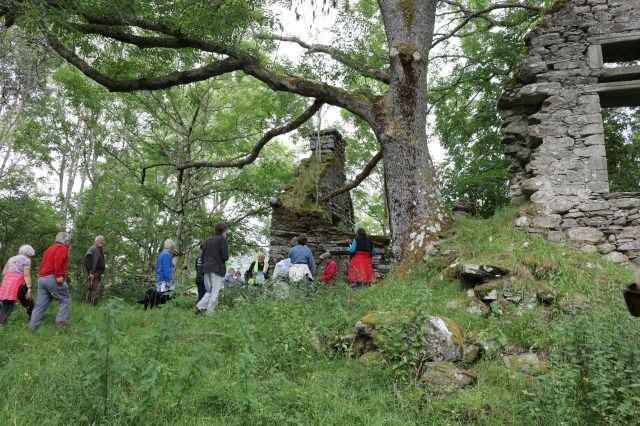
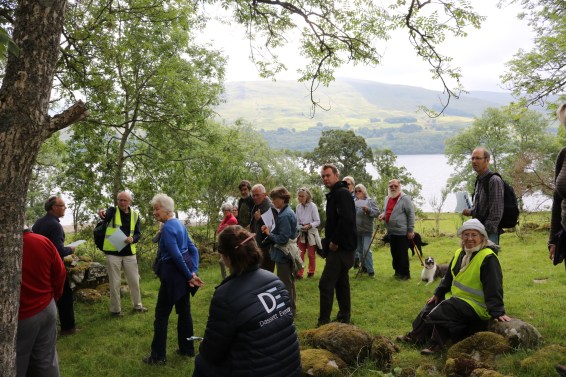
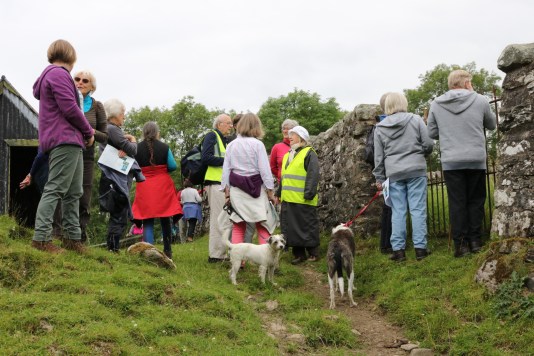
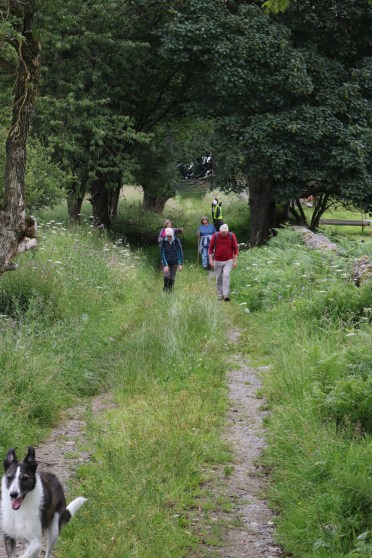
Last week, Neil Hooper of Fortingall Roots and the Breadalbane Heritage Society, led a walk round the ruined village of Old Lawers, a Scheduled Ancient Monument. The walk proved popular with both locals and visitors and so it was a good sized group that made its way down the track to the old village.

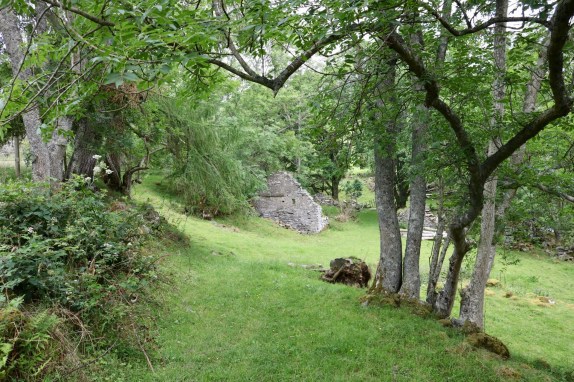
The track through the fields was almost a time-tunnel, taking us away from the sounds of the modern world and into the atmospheric stillness of the deserted village.

One of the earliest references to Lawers was in 1160, when Malcolm IV granted the barony of Lawers to the MacMillans of Argyllshire and it appears to have been occupied up until sometime around the 1920s.

The remains of the pier still protrude from the water, and are a reminder that the Loch Tay Steamboats used to stop here on their way up and down the loch.

IMG_2913

Remains of the old pier in the water

But for centuries before the steamboats, people and goods were ferried up and down the loch, some calling into Lawers on their way. Cattle being brought to market from the south side would be swum across the water to Lawers and there was a time that, on a Sunday morning, half the congregation of Lawers church would arrive by boat from the other side of the loch.IMG_2908

From the pier, following the path round the edge of the loch, we passed the remains of the Laird’s House.  This house was built after an earlier castle (or fortified house) of the Lairds of Lawers was destroyed in 1645.

The old village is, of course, famous for the prophesies of a former resident, the Lady of Lawers.  She is said to have been a Stewart of Appin, married to a brother of the 6th Laird, Sir James, and to have lived in the Laird’s House around the mid 17th Century – although there are no records that support this.

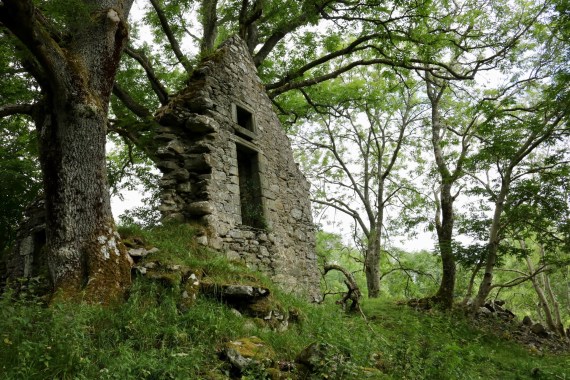
A number of her prophesies relate to the kirk next to the Laird’s House. When Lawers Church was being built in 1669, she had watched as the ridging stones, brought from Kenmore by boat, were left on the shore ready for installation the next day. This prompted the first of her prophecies “The ridging stones shall never be placed on the roof of the church.” She was quickly proved right, as that night a violent storm blew up and the stones were washed into the deep waters of the loch, beyond reach.

IMG_0714

Walking round Old Lawers Church

An ash tree planted close to the new church was the focus of further predictions. “The tree will grow”, said the Lady of Lawers, “and when it reaches the height of the gable the church will split asunder.” This was taken to foretell of the Great Disruption of 1843 when the congregation of Lawers left the Church of Scotland and joined the Free Church.

She made two further prophesies about the ash tree:

“When the tree reaches the ridge of the church, the House of Balloch will be without an heir.” (The tree reached the ridge in 1862, the same year the Marquis died without an heir.)

“Evil will come to him who harms the ash tree.” (Many years after the prediction, in 1895, a tenant of Milton farm cut down the tree with an axe. Shortly afterwards, he was gored to death by his own Highland bull and his neighbour, who had assisted him, went mad and had to be committed to an asylum. Even the poor horse that dragged the tree away inexplicably collapsed and died.)

IMG_0697

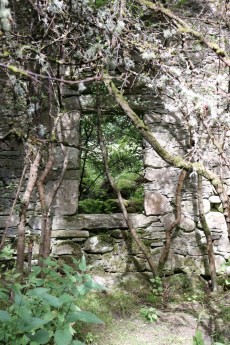
Other trees now grow around, and in, the ruin of the Kirk, but the gable end still stands with the window that would have provided light by which the minister, aloft in his pulpit, read from the bible to his congregation and delivered his sermon.

The Lady of Lawers made many other prophesies about the area, both economic and social, and you can read more about them here.

Moving on, we paused at the ruins of one mill and looked down what had been a cobbled lade culvert, towards a second mill and beyond that to the Lawers Burn, which gave the village its name.  Although it was flowing gently on the day of our visit, the name means the noisy burn, referring to the clatter it makes when in flood, as it races down from the mountain above.

IMG_2877


IMG_0701

After the mills, we crossed an old wooden bridge over that noisy burn and walked across a field to reach the old burial ground, Cladh Machuim, behind its high drystone walls.

There are a number of graves inside the enclosure and it appears to have been in use over many centuries.  Amongst the gravestones (some relatively recent) are some old, incumbent, roughly-hewn slabs, one of which bears the initial M and the date 1786, and another the initials W M and the date 1531.

In a small tool shed outside the burial ground, there is an ancient font from a church.


IMG_2858

And then it was time to leave and make our way back up the track thinking, perhaps, of the three prophesies of the Lady of Lawers that remain unfulfilled:

“A ship driven by smoke will sink in the loch with great loss of life.” (This is believed to  have deterred a number of would-be passengers in the years of the Loch Tay Steamers.)

“The time will come when Ben Lawers will become so cold that it will chill and waste the land for seven miles.”

“A strange heir will come to Balloch when Clach an Tuirc (the Boar’s Stone) at Fearnan topples over.”

Will they come to fruition? Who can tell!

IMG_0710

If you are interested in joining one of Neil Hooper’s guided walks, keep an eye on The Quair, where they are listed in advance.

Posted in Uncategorized | 1 Comment

A Strawberry Feast

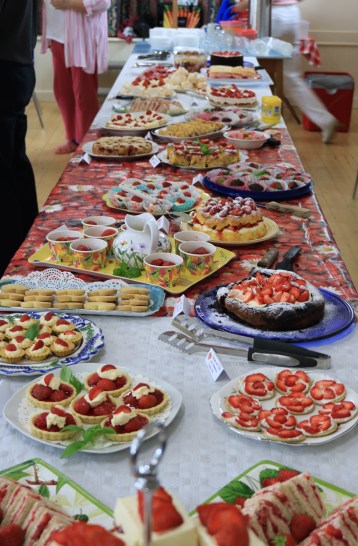
Any lingering doubts that the weather (rain) or competing events (the Women’s Final at Wimbledon) might affect the turnout at our Strawberry TeaZ last Saturday were quickly dispelled. It was a hugely successful event, with over 50 people coming to help eat the magnificent spread of strawberry goodies.

And what a lovely mix of people, including residents, former residents, visitors staying in Kenmore and in the village (including Shoreside and Boreland), some of our ‘regulars’ from Fortingall and some cyclists from Keltneyburn.

Doug and Hilary played a great selection, adding to the happy atmosphere and providing the chance for some spontaneous outbreaks of singing.

Many thanks to all those who helped with the preparation and set up for our Strawberry TeaZ – a lovely way to mark the summer, even if it was raining outside!

Oakbank Crannog

A few months ago, the Fearnan Blog featured an article on Oakbank Crannog – one of the two crannogs just off-shore from the village – which was was first excavated about 35 years ago. On the 10th July this year, the Scottish Universities Environmental Research Centre team, along with Nick Dixon and the Scottish Crannog Centre, returned to Fearnan all set to discover new information about the site using the latest dating methods.

If you would like to read more about their work in Loch Tay, you can follow their Twitter feed about the excavation here including the day when a beaver swam past the excavation site! (See photo on the right below).

The Book Club

As the Hall is already booked on the Book Club’s usual day, the next Book Club meeting is on Monday 14th August.  The book is Alone in Berlin by Hans Fallada. Inspired by a true story, it is the gripping tale of an ordinary man’s determination to defy the tyranny of Nazi rule.  It is also a film, directed by Vincent Perez, and playing at the Birks Cinema this month.
What’s next?
Our next event is on Saturday 16th September. Join us for a light lunch –  Soup and a Roll – in the Hall at 12.00.
Posted in Uncategorized | Leave a comment

Update on Events

The June Coffee Morning was a well-attended, warm and friendly event, with some familiar faces, some new faces and some visitors who were staying in the village.

We had our first canine attendees: Frankie the golden retriever, Hamish the border terrier, and Caileag the black lab. They arrived with the walkers and seemed to enjoy themselves, despite the fact there were no plates of Bonio biscuits amongst all the other goodies on offer.


We’re now getting ready for our Strawberry Tea event on Sat 15th July at 3pm in the hall.  And just to remind you, here’s a picture of last year’s spread…………

IMG_1405

It’s afternoon tea with a difference and everyone is welcome (residents, visitors and passers-by) to join us for this feast of strawberry delicious-ness.  We would be delighted if you would like to make or bake a contribution, but please let Sue know on 830493 (it helps with the planning).

Doug and Hilary will be providing the live music.  It’s pay at the door as usual, £7 pp for as much as you can eat, school age children are half price and under 5’s get a free pass.

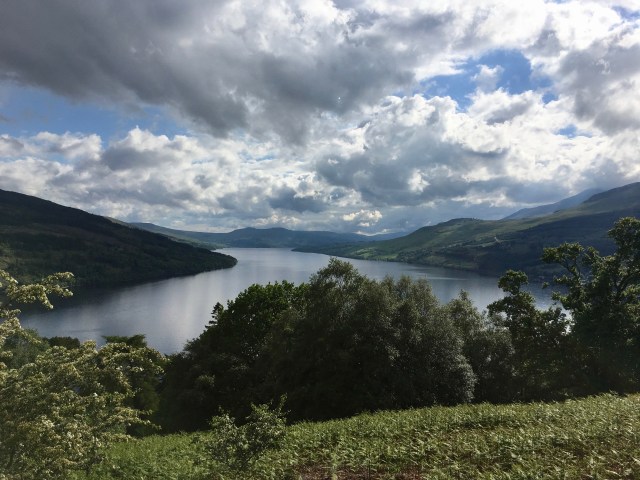
Work is continuing to clear the bracken around the site for the seat that Ian McGregor is gifting in memory of his wife, Ann.  The view from the site is quite fantastic.

IMG_2740

Many thanks to all who have lent muscle power to bash the bracken so far.  We need to keep going with this, and further contributions will be very welcome (what better way to work off the small number of calories you might consume at the Strawberry Tea?).

This month, the Book Club is reading The Kalahari Typing School for Men. It is the fourth in The No 1 Ladies Detective Agency series of novels by Alexander McCall Smith which are set in Gaborone, Botswana and featuring the Motswana protagonist Precious Ramotswe.This was chosen as a light-hearted summer read as many of the group are fans of Alexander McCall Smith

The next meeting of the Book Club is on the 12th July in the hall.


Posted in Uncategorized | Leave a comment

A Special Visit, and Other News

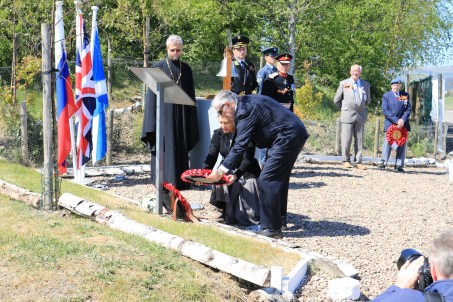
In the spring last year, we featured an article on the Fearnan Air Crash which told the story of the Russian Airmen who were based at Errol on a top-secret mission, arranged in conjunction with the British Air Ministry. Three of the airmen, along with a Czech colleague, died when their plane crashed in the Cow Park in 1943.

Our ability to tell the story in such detail was due to Anna Belorusova contacting the Fearnan Blog.  Anna wrote to us when she was researching her grandfather’s wartime service, and she has since written a book (to be published shortly) on the experience of the men of the Moscow Special Assignment Air Group who were stationed in Errol for part of the war. The book features a section on Fearnan, and the crash in the Cow Park.

On the 9th May this year, Anna and two other descendants of the Russian Airmen came to Fearnan to visit the crash site.  For Anna, it was her second visit, and this time she brought Valery and Peter Petrovichev, the son and grandson of one of her grandfather’s fellow airmen.  Both have followed in Grandfather Petrovichev’s footsteps and the family now has three generations of airmen. Bradley Borland, one of the custodians of the Errol Airfield and its history, accompanied them to Fearnan.

The 9th May is V-Day in Russia (similar to VE Day in the UK) when servicemen and women are honoured, so it was a very appropriate day for them to visit the crash site.

From the crash site, we went to the War Memorial, where Anna, Valery and Peter left a wreath in memory of their countrymen who died so close to the village. For Valery, it was the realisation of a long held an ambition to visit Scotland and see the places where his father served in WW2.

At a ceremony held at Errol Airfield earlier in the day, Anna and Valery had laid a wreath to commemorate the role of the 60 Russian pilots, navigators and engineers who were based in the Carse of Gowrie.

IMG_2996

Anna and Valery laying a wreath at Errol Airfield

Valery and Peter live in Moscow and they were much taken with Fearnan’s hills and mountains, the loch and the different flora and fauna in Scotland.  Lots of photos were taken, while the lambs on the Brae were the cause of much amusement. In Russia, sheep are reared in the Caucausus region, so lambs gambolling in fields are not such a familiar sight.

Next year will be the 75th anniversary of the Fearnan Air Crash and Anna is working on a plan to mark the occasion in conjunction with the Russian Consulate and colleagues at the Errol Air Base.

IMG_3173Valery and Peter brought a gift for Fearnan to thank us for helping to keep alive the memory of the airmen who died in 1943.  It is a model plane that is the symbol of Vnukovo Airport, which was the Russian base of the Moscow Special Assignment Air Group. The plane is a TU-104, Russia’s first commercial jetliner, and we shall put it in the glass cabinet in the Hall.

Ann’s Seat

Meanwhile, across on the other side of the Cow Park, work was starting to clear a space for a special seat which is to be installed at the top of the path from Quarry Road to Drummond Hill. Ian McGregor is gifting the seat in memory of his wife Ann who died last year, and it will mark a spot where they often sat to admire the wonderful view down the loch and to the hills beyond. A number of volunteers met to start the process of clearing the bracken around the spot, although there is still a lot of work to  be done.

The FVA has bought some tools for the task and if you’re interested in volunteering for some bracken bashing, please contact The Blog and we’ll try and arrange dates that suit most people.  The tools are available anytime for volunteers to use.

May Coffee Morning

The May Coffee Morning was well attended and provided a chance for much catching up and chat. Looking at the photos below, I’m just wondering if I missed the announcement that striped tops were to be worn!

What’s On?

 The next Coffee Morning is on Tuesday 20th June at 10.30 am in the Hall and our summertime extravaganza, Strawberry TeaZ will be served on Saturday 15th July at 3pm in the Hall.

The May Book Club met to discuss “Secret Scriptures” by Sebastian Barry. It stimulated a range of responses around the rich language and the plight of the main character. The film is currently showing at the Birks cinema in Aberfeldy and some book club members have expressed interest in going to see it.

Next month’s book is To be Continued by James Robertson described as a “madcap Highland adventure from the Booker-longlisted author of And The Land Lay Still, and The Testament of Gideon Mack”.

 The Group previously read his earlier novel The Testament of Gideon Mack which most enjoyed. It has been agreed that in future the group will meet on the 2nd Wednesday of the month, which means that the June meeting will be held on the 14th June. 


Posted in Uncategorized | Leave a comment

Fearnan in the Picture

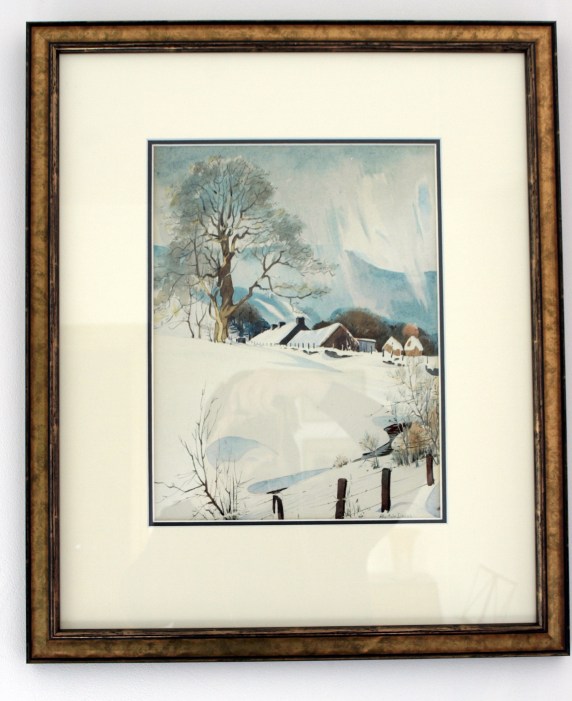
This week, we start with a little tale of some recent detective work. It involved a painting and was a bit like an amateur version of the BBC’s Fake or Fortune programme – except we knew all along exactly who the artist was; it was the location that we were trying to verify.

It all started when Bill Craig, who lives in Dumfries and Galloway, emailed The Blog to ask if we could pinpoint the location of a painting by the artist, Alastair Dallas. Bill inherited the painting, and when it was re-framed he discovered the inscriptionClach Eurich, Fearnan. Alastair Dallas 1944.”

Did this location still exist, he wondered?

The watercolour is a very attractive landscape but the name, and indeed the location, had us scratching our heads.

OLYMPUS DIGITAL CAMERA

Clach Eurich by Alastair Dallas. Image appears courtesy of Wm Craig.

Alastair Dallas was a professional artist who was based in Kirkcudbright – but what was his connection with Fearnan, and where had this picture been painted?

The first step was to contact two other Alastairs (or, to be exact, an Alastair and an Alistair). That’s Alistair Kininmonth, who has a lifetime’s knowledge of this area, and Alastair Barnett (now in British Columbia) who was at school in Fearnan at the time the picture was painted.

But neither of them could place the picture or the name, Clach Eurich. Alastair B, however, did remember the artist:

“I remember Alastair Dallas. He visited during the summer and rented the cottage next door to Springbank Cottage.

“He was a colourful character dressed in kilt and Deerstalker hat. Usually, he was accompanied by one or two young men and he didn’t seem to mind us children tagging along with him and his companions when he’d walk by the loch. (I remember one of his young friends was called Robin.) 

“Dallas painted a small picture of Springbank and it hung by the fireplace in the front room of the Butters’ cottage.

I don’t remember him ever being in the village in winter.”

 That last sentence suggested the possibility that the picture might been painted in Dallas’ studio, based on sketches made during one of his visits to Fearnan. But where had he been sketching?

The next port of call was the Fearnan Archive, to see if there were any references to Clach Eurich or find any other clues that might help with the mystery. And, hey presto! A photo of Dalchiaran in the snow, probably taken in the 50’s or 60’s, started to look promising.

IMG_2630

That tree looks very like the tree in the painting. The roof lines are right. Neither tree nor cottages sit on a hillside, but the land does start to rise behind the cottages, as the second photo (below) shows. Both photos were taken around the same time.

There’s no burn on that side of the road, and there is one on the other side of the road – so we have all the component parts of the picture but just not in the right order! Perhaps, just perhaps, Dallas made individual sketches in Dalchiaran and used artistic licence to create a dramatic landscape higher up the hill, along with a sketch of the stream from the other side of the road to fill the foreground.

Dalchiaran Cottages

Photo taken (1950’s or 60’s) on hill behind Dalchiaran Cottages, looking towards Boreland Farm

After 73 years, I’m not sure that we can get any closer than that – unless one of the readers of The Blog has another suggestion. Please get in touch if you can throw any further light on this, or on the name Clach Eurich. Sue spotted that it is not dissimilar to Clach na Cruich (or The Measles Stone), but the picture doesn’t depict either the stone or the field in which it sits and which is named after it. In the 1940’s, the cottages did not have individual names, but were known as Cottages 1-4, Dalchiaran, so it can’t be a house name.

Does anyone know what happened to the picture that Alastair Barnett mentions of Springbank Cottage? And are there any other pictures of Fearnan by Alastair Dallas? Please contact The Blog if you can help.


Social events continue apace, and the April Coffee Morning was a very enjoyable and sociable event, with lots of chat and people catching up after Easter.

It was very well attended and numbers were boosted by the Walking Group who arrived ready for coffee and cake after their exertions.

And following hot on the heels of the Coffee Morning was the latest Charity Quiz Night run by the Hall Committee, and which raised over £200 for the Scottish Charity Air Ambulance Service, and Hall Funds. Our Star Baker (Frances) won the Star Prize in the raffle – a spanking new TV! Many thanks to Tricia and Tom Coyle for generously donating this prize.

The next event is the May Coffee Morning, on Tuesday 23rd May at 10.30am in the Village Hall.


Posted in Uncategorized | 2 Comments

Fearnan Village Association’s 10th Anniversary

Last Saturday we celebrated the 10th anniversary of the FVA, and 10 years of social events and of providing a collective voice for the village.

The birthday party was a very warm and friendly occasion – and a chance to enjoy a delicious afternoon tea along with a glass of fizz.  The Hall was looking splendid, all beautifully set for tea, while Fran and Elaine’s ‘proper’ china tea sets added a real touch of class.


This anniversary seems a good moment to have a quick look back at the past 10 years, and to remember the fun, the friends and, of course, the food! So here’s a short(-ish) selection of the many, many photos we’ve taken over the years.  They are more or less in chronological order ………………

And it’s all been done with ………

IMG_7539

If you’re in the mood for more, there’s a Coffee Morning on April 25th in the hall at 10.30am.

But before that, there’s another Quiz Night on Saturday 22nd April at 7pm in the Hall.  It’s £7.50 per person, which includes a two course supper and as many quiz questions as you can answer. There will be a raffle and proceeds are in aid of the Scottish Charity Air Ambulance, and Hall funds.

Posted in Uncategorized | 1 Comment

Spring is Here! (+AGM Minutes)

Spring seems to have arrived in Fearnan – the daffodils are dancing in the breeze, lambs are gambolling in the fields, the days are getting longer and we’ve even enjoyed some warm and sunny days.

Spring means the end of the season for the Indoor Bowls Club, and the awarding of prizes to members. This year’s Star Bowlers are Angela Kininmonth who triumphed in the Singles Final, and Alastair Kininmonth and John Raeburn who lifted the Doubles Cup.

Well done to them! The Club restarts in the Autumn, and any prospective new members will be very welcome to come along and have a go on the first Monday in October. (Look out for an article on this on the Blog nearer the time.)

 We’re very impressed to see how relaxed Angela and Alastair look, given that the lambing season is in full swing, and the maternity units in Ewetopia will be very busy. Peter McKenzie has already been up with his camera, and shared these delightful pics of some new arrivals.

Forthcoming Events

Join us for tea in the Hall on Saturday 15th April at 3pm to celebrate the FVA’s 10th Birthday. Free to members and their guests.

The April Coffee Morning is on Tuesday 25th at 10.30 in the Hall, when the usual spread of baking, savouries and hot-off-the-griddle pancakes will be available, along with freshly made coffee and tea.

Annual General Meetitng

The FVA Annual General Meeting took place at the end of March, and here are the Minutes.


Fearnan Village Association

Annual General Meeting and Business Meeting

25th March at 4pm, McLean Hall, Fearnan

 Welcome

The Chair, Sue Gardener, opened the meeting by welcoming members. She explained that the format of the afternoon would be: the FVA Annual General Meeting, followed by the Business Meeting.

ANNUAL GENERAL MEETING

 Apologies

 Apologies were received from Cath McGregor, Ros Grant, Nick Grant, Graham Liney.

Adoption of the Minutes of the 2016 AGM and Business Meeting

 The adoption of the Minutes for the 2016 AGM, was proposed by Neil Ballantyne and seconded by Keith Brockie.

Chair’s Report

 The chair reported that the FVA is 10 years old this year and continues to fulfil its original objectives, which are:

  • To provide a forum for discussing issues which affect the village and agreeing and taking appropriate action where necessary.
  • To organise social events.

Issues this year have included:

Flooding and Drainage: the problems experienced in the village in Spring 2016 were addressed by providing information to, and liaising with, the Community Council and PKC Roads Department as well as supporting affected individuals.

The Cow Park: the FVA was approached by one of the owners to see if Fearnan had an appetite to purchase the Cow Park. Some initial research was conducted, and a village meeting to discuss the proposal was hosted, leading to the formation of a steering group to take the project forward.

Scrap and Land Management: the Association has supported the Community Council in tackling the environmental problem of scrap and land management in and around the village by: ensuring that the regulatory and enforcement agencies have the information they need to take action; making a formal complaint about the impact on the whole village; supporting complaints made by individuals; and keeping the membership updated.

Communication: the Fearnan Blog has gone from strength to strength as a means of communication, and its articles on Fearnan’s social history have been enjoyed and reached the readers around the world.

Attendance at the Remembrance Day Service has increased, and it has benefited from coverage on the blog and the offer of refreshments afterwards in the hall. The Association’s interest in the War Memorial has led the Community Council to lobby PKC for improvements.

Broadband provision is still inadequate overall, but the AB Internet initiative has been supported through the dissemination of information and is now in use by several households.

The regular social events provide an opportunity to meet friends and neighbours and continue to be supported and enjoyed by visitors as well as villagers.

Finance Report

The key points from the Treasurer’s Report were

  • the organisation had £5468.37 in the bank at the end of the financial year.
  • membership currently stands at 63.
  • ten events were held this year. Year-on-year, income from the events dropped slightly, mainly due to a slight dip in the average attendance, and therefore income, at Coffee Mornings. The Armistice Day event is free-entry, but attracted £65 in donations for Help for Heroes.
  • the main expenditure is venue costs and reimbursement of expenses for ingredients etc.
  • the FVA gave the Cow Park Committee £200 pounds for expenses and research, and this was returned when the offer of sale was withdrawn.

Jim fair was thanked for checking the Books at the end of the financial year.

Committee Membership

 There were no resignations and no changes to the membership of the committee in the last year.

AOCB

There were no items and the chair declared the AGM closed, and moved onto the Business meeting.

FVA BUSINESS MEETING

 Fearnan Issues

Scrap and Land Management: An update on the situation was circulated by email on the morning of the AGM. The lay-by at Balnearn has been cleared, although it was thought that some of the scrap had been moved onto adjacent land. An Amenity Order has been issued to clear Dalchiaran in the next month, and another notice has been served in relation to water run-off at Balnearn.

The matter will be on the agenda at the next Community Council Meeting, which is on 4 May at 7:30 PM in Glen Lyon Primary School.

Cow Park: A working group was formed to take forward the village’s interest in purchasing the Cow Park but shortly after its formation, the offer of sale was withdrawn.

There was a discussion at the AGM during which members of the community expressed their concern at the state of the Cow Park and disappointment that the SNH Management Plan was not to be implemented.

There was a discussion on a number of related issues, and a minute of the discussion will be passed to the members of the Cow Park Group.

Blog Report: The Blog continues to be widely read, not just in Fearnan, but by Fearnan fans in countries around the world. Last year, we established an on-line contact in Russia and she is about to publish a book telling the story of the Russian Airmen who came to train at Errol during WW2. It covers the air crash at Fearnan, and includes quite a bit about the village itself. The author and another descendant of the Russian airmen will visit the village in May.

Village Map: A proposal to produce a map of the village has been put forward. It was agreed that it should be a multi-purpose map i.e. useful to visitors as well as residents, and capable of being mounted on an information board somewhere prominent in the village, as well as going on the blog and being distributed to residents. The suggestion of using a drone photograph of the whole village as the basis for the map was made. Some funding towards this by the FVA was approved.

Staying Connected: A proposal to promote good neighbourliness has also been put forward and the idea is to make sure we all know who our neighbours are, and that we can support each other if needed. It is proposed that contact information for willing residents is compiled so that quick communication is possible if something happens. Information might also include useful contacts. Inclusion would be entirely voluntary and it would only cover those who wish to be included. It could also have Added Value by providing a network of people who are willing to offer help e.g. by collecting prescriptions or doing shopping if someone was ill. The idea met with approval and Fran Donovan will take this forward. She would like to hear from volunteers who could form a group to work out the best way to set this up.

Broadband: AB Internet now provides a 10mps (approx.) service to the village, but it is dependent on line-of-sight with the mast.

War Memorial: The existing steps are dangerous and cannot be replaced as they constitute a traffic hazard on the corner. Following an approach by the FVA, the Community Council agreed a plan with PKC for the mounting of a stone ‘wreath holder’ at the front of the memorial, which means there will be no need to climb up to lay wreaths. Drawings are being prepared and will be circulated for community opinion before a final decision is taken. Any maintenance required on the retaining wall will also be carried out.

Fearnan History: Ian McGregor is giving the administration of his book to the FVA. Fran now has most of his papers. A reprint is needed, and in future the FVA will pay for the reprints and retain income from sales. A small print run is needed now for the summer season, but in the future, the new map (see above) and social history articles from Blog could be included in a revised version of the book.

Social Events and Dates: The dates of forthcoming events are on the What’s On page on the Blog. At the meeting it was decided to change the Coffee Morning on the 12th September to a Soup and Roll Lunch on Saturday 16th of September. It was suggested that events should be advertised on the noticeboard at the Co-op in Aberfeldy.

Fiona will look for a suitable temporary sign for outside the hall to promote FVA events when they are on.

AOCB

The Community Council has been asked to support the planting of the tree at the site of a light aircraft crash outside the village about 15 years ago, and in which the pilot was killed. The area is due for felling, and there is a wish to mark the site before the felling takes place. The meeting agreed a small contribution might be made from funds if this was deemed appropriate.

The Chair closed the meeting by thanking all members, and the committee members, for their contribution to a successful year for the Fearnan Village Association.


Posted in Uncategorized | Leave a comment

Fun and Games in Fearnan!

The Village Hall hosted a Games and Curry Night at the beginning of March, and judging by the smiles in the photos below, it was much enjoyed by the participants.  Most of us were trying not to count the years that had passed since we last played table tennis, dominoes or tiddly-winks and also trying not to be too inept.

Guy, who’s hand was very clearly out of action in a bandage and sling, should probably have been given a generous handicap.  But having said that, he still managed to out-play several of us at table tennis!

Elaine demonstrated how to play Quoits……….

………… and although she made it look easy, not all of us were able to emulate her style (as the 3 ‘misses’ in the photo show).

All thoughts of winning, high scores and personal bests were quickly forgotten when, after a flurry of activity in the kitchen, a delicious selection of curries appeared, followed by home-made ice-cream and sorbets. A great finale to the evening.

Later in the month, a somewhat less energetic but equally sociable Coffee Morning was held – the first of the year. As ever, there was an excellent spread of goodies,  including warm pancakes made on the spot, savouries, cakes and biscuits.


More Events Coming Up!

Fearnan Village Association’s AGM will be held on Saturday 25th March at 4pm in the Village Hall.  All members welcome.

The FVA is 10 years old and and like every ten year old, we love a good birthday party!  Join us for a celebratory afternoon tea on Saturday 15th April at 3pm. Free to members and their friends.

There’s also a Coffee Morning on April 25th at 10.30am in the Hall.


If you enjoy a good read, the Book Club are reading Joanna Cannon’s debut novel, The Trouble with Goats and Sheep, a funny and moving portrayal of suburban life in 1970’s Britain with an intriguing mystery at its core. They will be discussing it on the 12th April in the Hall at 7.30pm


Posted in Uncategorized | Leave a comment

Fearnan 500 BC

To the casual observer, Fearnan might appear to be a relatively recent settlement. There are a few older croft properties, but most of the houses in the present-day village were built within the last 50 years.

However, closer examination reveals signs of habitation around the village from as long ago as the Bronze Age (the Boar Stone), from the early Christian era (a grave stone in the burial ground and the font from St Kieran’s church), and from the late medieval period (the Market Cross).

But perhaps the most famous and revealing monuments are physically out of sight – they are the 2 Iron Age crannogs, which lie beneath the waters of the loch, just off-shore from the present-day village. These are the remains of artificial-island dwellings, built and inhabited by a farming community some two and a half thousand years ago.

In the 1980’s, one of these crannogs, Oakbank, was the first underwater site in Britain to be excavated and to do this, new archaeological methods had to be developed for both excavating and recording the findings.

img_1998

Scottish Crannog Centre, Croft-na-Caber

The excavation has hugely informed the understanding of our Iron Age ancestors, and of life in the Iron Age.

Not only that – it has led to the reconstruction of a crannog, based on the one at Oakbank, on the Loch at Croft-na-Caber.  This makes it possible to imagine how Fearnan might have looked 2,500 years ago.

The landscape is not thought to have changed a great deal in the intervening period so, take away the houses in your mind’s eye, and imagine 2 crannogs – one at Oakbank and one just off-shore at Shoreside; you might see smoke seeping through the roofs from the hearths inside the crannogs; you might hear young children playing and see the older children and adults from the extended family watching over grazing animals and tending their crops.

It is the cultivation of the land  that creates a direct link between the iron age farmers and Fearnan today, because the present day crofts and houses sit on the same land that was farmed by them 2,500 years ago – and by countless generations both before and since the crannog-dwellers. Once cleared, probably about 3,000 years ago,  the fertile land was far too valuable an asset to be abandoned and it has been under continuous cultivation ever since.

Written information about the crannogs starts as far back as 1590.  Timothy Pont’s Map of Loch Tay (of which there is a copy in the village hall) refers to “Krannichs”, and the old tradition spoke of 24 artificial islands in the loch.  In 1938, William Gillies in his book In Famed Breadalbane, gave the position of 13 of these islands and expressed the opinion that more could be identified by a careful survey.

Forty years later, in 1979, that survey was carried out by Dr Nick Dixon, who is now a Director and founder member of the Scottish Trust for Underwater Archaeology, but at that time he was conducting research at St Andrews University. He identified the remains of 18 crannog sites, all in an excellent state of preservation due to the cold peaty waters of the Loch.

Oakbank Crannog was selected for excavation because of its shape, size and the fact that there were the remains of a walkway from the shore to the crannog.  This suggested that, of all the crannogs in the loch, it was most likely to yield interesting information.  Today, Nick smiles at this memory, and remarks that if he had known just how much was down there, he might have picked the simplest crannog in the loch instead!

img_2090

Alder post marking Oakbank Crannog

A single post of alder wood in the water marks the spot where Oakwood Crannog stood.  This was put in some 20 years ago, when Nick and his colleagues were experimenting with construction methods ahead of starting the building at Croft-na-Caber.  The post was cut to a point and driven into the lochbed. Its continuing presence demonstrates how well the lochbed clays grip and hold structures.

In his book, William Gillies talked of the difficulty of constructing these substantial structures in the Loch. The excavation at Oakbank enabled the archaeologists to determine just how substantial they were. The floor was constructed of three levels of small alder trees lying parallel on top of each other. Around the floor were the upright stakes and piles that supported the walls and roof of the house. Forty elm and oak stumps mark the remains of a walkway that led to the shore.

The archaeologists have found evidence that Oakbank Crannog was rebuilt some 6 times, following the collapse of all or part of the main structure.  Each collapse would have added to the growing mound of debris under the crannog, and latterly the support piles that needed to be sunk into the loch would have been driven into the old debris, rather than the lochbed clay. This would have produced a less stable result, and so large stones and rocks were dropped to help hold the piles in place.  Over time, a small man-made island would be built up under the crannog.

Unknown

Diver working at Oakbank (photo courtesy of N Dixon)

What is extraordinary is the wealth of information and the sheer volume of artefacts that have been unearthed from what appears to be a mound of stones. Under these stones is a mass of well-preserved organic debris from the crannog’s platform and the dwelling it supported, along with the abandoned material left by the inhabitants.  Loch Tay’s waters are dark, peaty and cold and this helps with the preservation of materials. But perhaps the best preserver was the mound of bracken and ferns with which the crannog-dwellers covered their floor to make the building comfortable.

Bracken is full of tannins that have a preserving effect and amongst the bracken and ferns the underwater archaeologists found many of the objects that people had used in their everyday lives. Wooden plates and dishes, the remains of a wooden drinking cup, a wooden spoon, and a butter dish with the remains of butter still sticking to it, have all been uncovered. The discovery of cultivation implements provided evidence of agricultural practice, along with the presence of an early form of wheat.  The wheat was unexpected as it had not been thought to be present this far north until some 500 years later.

Animal bones, and sheep droppings with parasite eggs still preserved in them have been found, as well as a fragment of fine textile not suspected from this early date in Scotland.

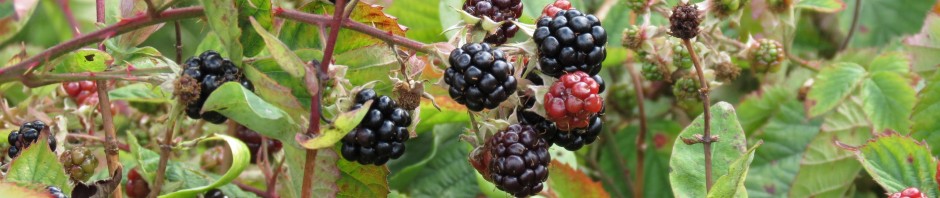
We now know that their diet included strawberry, blackberry and cloudberry (which only grows on the high moorland above 700m) so the crannog dwellers must have made special trips to collect it. Or perhaps, like the generations of farmers that followed them, they took their sheep up to exploit the higher pastures in summer. Herbs and medicinal plants were also found, and if you have been struggling to eradicate any of these pretty things from your garden…….

…………. you may (or possibly, may not) be interested to know that they have been growing in the area for at least 2,500 years!  But then they would have been prized for their medicinal benefits.  Fat Hen (chenopodium), so called because it was used to fatten poultry, was used for liver complaints, as a mild laxative, for skin irritations, and for relieving arthritis and rheumatism.  Plantain (plantago), apart from being nutritious, has been widely used in poultices and lotions, and has anti-inflammatory effects. It is also rich in tannin and allantoin, both of which help injuries to heal. The uses of buttercups (Ranunculus) include treating headaches and, shingles, and sciatica.

Unknown-1

Support platform for underwater excavation of Oakbank Crannog. (Photo courtesy of N Dixon)

The discoveries at Oakbank have not just revealed a wealth of information on how the crannog-dwellers lived as a community, but also on how that community interacted with the outside world. Some of the artefacts found did not originate in the area around Loch Tay – or even in Britain, for that matter. Opium poppy seeds found here, but originating in Afghanistan, must have been traded. A black jet bead, possibly from Whitby, must have been acquired through a trading arrangement. And an iron knife, which would have been a prize possession, must also have been acquired from outside the area. The River Tay provided a trading route and had the potential to connect the crannog-dwellers to traders not just from other parts of Britain, but also from the Continent and beyond. Paddles discovered in the remains of Oakbank Crannog confirm that the water was used as a transport route.

But why were the crannogs built? Were they for defence, or purely practical? There are several possible answers to this. One theory is that it was for security, as the crannog provided a defensible site and a means of keeping their animals safe from on-shore predators. However, it is also clear that the structures would have been highly visible for miles away from the hill tops. Not ideal from the security point of view.

Another possible clue is that at the end of the Bronze Age, which spanned the second millennium BC, there was serious change in the climate and the weather became colder and wetter. This resulted in pressure on the land and resources and led to the construction of different types of structures during the Iron Age such as hillforts, duns and monumental roundhouses.

This is also the period in which crannogs were built. Land that had been laboriously cleared and then cultivated would have become highly valuable for sustaining the community and there was a logic to moving dwelling houses offshore to maximise the space on which crops could be grown and animals grazed.

The fact that these dwellings could have been seen from afar, combined with obvious status symbols that were found during the excavation (for example a bronze swan-necked dress pin dating from 5 – 600 BC), suggests another reason for their construction. The people who occupied the crannogs were relatively wealthy people and so prestige and status may have been behind their construction.

We may never know the definitive answer – but we do know that the Loch holds other tantalising secrets.

One of them is a 12.5 metre log boat that lies on the bottom of the Loch.  It dates from around 1,500 BC and therefore sunk to the bottom in an accident some 1,000 years before the crannogs were built. Its significant size suggests that it was used for carrying cargo as well as people.

Discovered in 1994, it has been left in place on the lochbed, where it continues to be preserved by the cold, peaty waters, until technological advances reduce the cost of raising and preserving it on dry land.

Another extraordinary discovery was a submerged Neolithic woodland deep in the Loch. In a 160m strip on the loch bed, divers found well-preserved oak and elm timbers – some fallen, some still upright and protruding from the lochbed.  Samples taken indicate the trees are between 8,000 and 1,500 years old and it is thought that this underwater woodland represents the old natural shoreline of the Loch, which would have been some 10 – 15 metres from the current shoreline.

In amongst the submerged woodland, divers also discovered the preserved remains of a 4,000-year-old beavers’ lodge – a somewhat topical find suggesting that beavers can perhaps claim a historical right to be in this area!

This year, the 20th anniversary of the reconstruction of the crannog at Croft-na-Caber, the underwater archaeologists are to return to Oakbank for further excavation work. No doubt more detailed information about iron-age life, concealed and preserved for 2,500 years by the waters of the Loch, will be revealed.

In the meantime, The Scottish Crannog Centre, where more information about the  Oakbank excavation can be obtained, re-opens for the season on 1st April 2017.

(Many thanks to Dr Nick Dixon for his time and help in putting this article together.)

Posted in Uncategorized | 2 Comments

Fearnan Pudding Night 2017

Last Saturday, the annual Fearnan Winter Pudding Night arrived, bringing with it a wonderful smell of baking and a feast of deliciousness for FVA members and their guests.

Whether your preference is for warm ‘comfort’ puddings like Treacle Sponge, Rice Pudding or Cloutie Dumpling, or more sophisticated tarts, pavlovas and cheesecakes, there was something for everyone.

img_2549-3

The main problem was deciding what to choose and what to leave out, but we know of at least one person who solved this tricky dilemma by simply working his way, one by one, down the full list of puddings set out in the menu.  We take our metaphorical hat off in admiration!


As ever, the music was provided by Doug and Hilary Law who, we’re delighted to say, have moved into the village.  Here’s a little sample from Doug.

Take it away, Maestro………


There’s lots more happening in Fearnan, and the dates of forthcoming events are:

Saturday 4th March – Games and Curry Night in the Hall at 6 – 9 pm.

Tuesday 21st March – FVA Coffee Morning.  Join us at 10.30 am for coffee, chat and some delicious home baking.

Saturday 25th March – FVA Annual General Meeting in the Hall at 4pm.

Saturday 22nd April –  Quiz Night in the Hall. The cost will be £7.50 a head for adults and this year’s charity is the Scottish Charity Air Ambulance.

And finally ……..

In these parts, we’re familiar with road signs that exhort us to beware of Red Squirrels, Deer, or other wildlife. With it’s tongue very firmly in its cheek, The Blog has another suggestion borrowed from elsewhere!

63ee2d31-1b5d-474a-a1df-3b7c3b5685de

Posted in Uncategorized | Leave a comment