
Fearnan’s burial ground, known as Cladh-Na-Sroine, dates from the 16th century and was originally encircled by the old village of Stronfearnan. It is all that remains of the old village, which was demolished at the end of the 18th century.
 Although the earliest inscription on a gravestone is 1778, there is a much older stone, a recumbent cross-incised stone, that dates from the early Christian era.
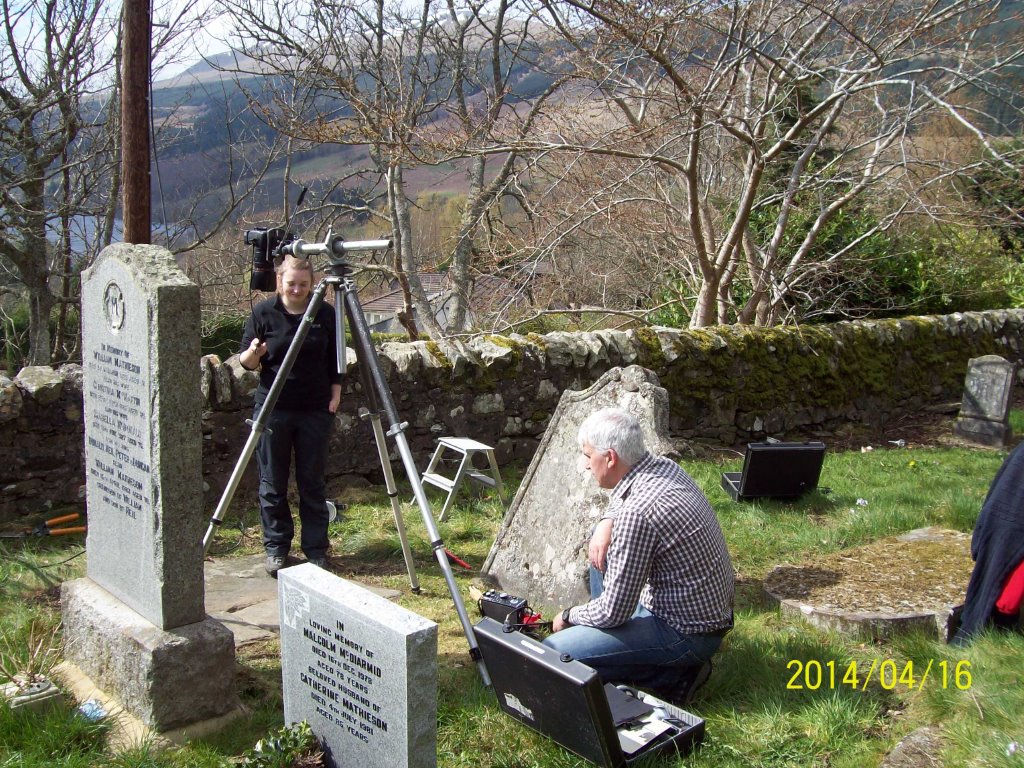
Two staff members from the Royal Commission on the Ancient and Historical Monuments of Scotland were in Fearnan recently to survey and record both this stone and the Baptismal Font – also from the early Christian era.
Christopher Rowley was quick off the mark and managed to capture this great photograph of them at work.

 Fearnan Village Association
I am descended from Alexander McGregor who spent some years in St `kitts as a Plantation manager. I have met some of his descendants out there and keep in contact with them. One of my ‘cousins’ is coming to visit me and would like to see Cladh-Na-Sroine Graveyard, Fearnan. It’s some years since I’ve been so could somebody help with directions of how to get there please. Rhona
Hi Rhona, I’m not sure which direction you will be coming from (ie from Kenmore or Killin) but from either follow the road along the side of the Loch to Fearnan and turn up Fearnan Brae at the war memorial (road signposted to Fortingall). Turn right at the top of the Brae and continue along the road passing a road on your left (Creagach). Just after Creagach, look for Bracken Cottage on your left and Cladh-na-Sroine is next. It is above the level of the road and you will see the old wall that surrounds it. There is a path up to the gate which is usually cut but the grass might be a bit overgrown at this time of year. It is marked as Fearnan Burial Ground on Google Maps. We love hearing about Fearnan people who went off round the world and would be delighted to hear more about Alexander McGregor and his family if you are happy to share. Contact me on Fiona@fearnanvillageassociation.com Best wishes, Fiona
Hi there, Great to find this site, what a beautiful place!
I wonder if anyone knows why the original Stronfearnan was ‘demolished at the end of the C18’? Was it anything to do with the Clearances? Are there any burial records available for for Cladh-Na-Sroine, or other records relating to Stronfearnan?
I’ve begun researching my family tree, and my 3xs Great Grandparents apparently both lived in Stronfearnan: John Menzies (19 May 1782 – 13 Jan 1859 – born and buried in Stronfearnan, according to records) and Isabel Arnot (1782 -1841 – Perth). John was listed as a labourer in his marriage cert of 1805, and as a crofter in Stromfearnan in the 1851 Census. His parents (and grandparents) were evidently also from the area, Duncan Menzies and Margret Mclean. At least some of his descendants migrated towards Perth, and then across the world to Canada, USA and Australia in the C19 and C20. Look forward to visiting Fearnan! best wishes, Frances
Hello Frances – good to hear from you. We love it when people with connections to Fearnan find our site! I can answer some of your questions. It was the old Village of Stron-Fearnan (dating from the 16th century) that was demolished at the end of the 18th century. The 4th Earl of Breadalbane then had new crofts built in a layout that survives to this day.The 4th Earl was attempting to introduce reforms to the farming methods on the estate. Stron-Fearnan was not affected by the Clearances.
Fearnan Village Association has copies of Ian McGregor’s book and I can arrange to send a copy to you. It costs £6.50 + postage. If you would like a copy, please contact me directly on fiona@fearnanvillageassociation.com to arrange this. I also have some other photos of the burial ground which might be of interest.
Fiona
Hi Fiona, thank you so much for replying so quickly, very interesting, and great that Ian McGregor’s book is still available, I’ll definitely be in contact by email! Best wishes, Frances
ps, I’ve refined the research a little, and it looks as though John Menzies may have migrated to Perth, and become a labourer there (in Tulloch), where he then met and married Isabella Arnot in 1805, and that they may have continued to live in (Tulloch) Perth, maybe until his wife died (in 1841); and that maybe he had family still in Kenmore, and was able to then return with his two youngest children, John and Margaret to become a crofter (with ref to Census 1851) -?
Does anyone know if this book is still available: Fearnan, the Story of a Highland Village of Northern Perthshire – the definitive history of Fearnan, from the Iron Age to the present day, by Ian McGregor -?
I’ve found this book online, which looks lovely, and very relevant to the area: My Highland Perthshire by Lavinia Grant.
with very best wishes again, Frances – London