
The Pop-Up Coffee Shop is Back
The FVA’s Pop-Up Coffee Shop returned to the village hall last week for the first time since the onset of the pandemic. Around 20 folk called in for a chance to catch up with old friends and to meet some new ones. As ever, there was a good spread of tasty home baking on offer.

The next Pop-Up Coffee is on Tuesday 11th October, 10.30 – 12.00 in the village hall.
Tackling Japanese Knotweed
Ros writes:
Japanese knotweed (JK), first introduced to the UK as a decorative garden plant in Victorian times, has now spread uncontrollably into the wild and especially near water. The plant looks spectacular and can grow rapidly as much as 10cm (4 in) in a day in summer and up to 2.1 metres (7ft) high overall. It has deep-rooted underground stems (rhizomes) which are tough, resilient and fast-growing – they spread easily without natural restraint and can damage buildings and roads. Rhizomes can reach 7.5 cm (3 in) in diameter and penetrate at least 2 m (7ft) in suitable soils (https://tinyurl.com/5n96hzv6). If pieces broken or cut off either stem or rhizome are left on the ground, the Japanese knotweed will grow again voraciously.
Some say it’s just nature but the problem with Japanese knotweed is that it prevents our native plants from thriving. Its rhizomes undermine riverbanks increasing the likelihood of flooding and disrupting salmon fisheries and access to rivers. In Scotland there is a Code of Practice for dealing with non-native species. It is an offence to plant non-native plants in the wild or allow them to spread into the wild, e.g. by allowing it to spread from your own land through inactivity, by dumping garden waste into the wild, or by moving contaminated soil (https://www.invasivespecies.scot/law-non-native-species).
In Fearnan, Japanese knotweed grows along the loch shore and inland by the burn that flows down by the Brae. We need to tackle this invasive plant before too much damage is done but fortunately help is at hand! The Scottish Invasive Species Initiative (SISI) is a 5-year partnership project which aims to work with local organisations and volunteers to control invasive non-native species along riversides in Northern Scotland, for the benefit of our native wildlife and communities.
Following the well-attended McLean Hall meeting in June about Japanese knotweed with SISI Project Officer Mark Purrman-Charles, four volunteers from Fearnan have undergone two days of training on how to control Japanese knotweed and apply the appropriate weedkiller. The initial phase of Japanese knotweed eradication will start in September and continue until the first frost. It will be necessary to continue to control the plant every year, during the period from July to the first frost and may take 3-4 years to complete or longer.
There are a number of important recommendations for tackling Japanese knotweed:
What to do if you have Japanese knotweed on your land:
- Identify the plant here: https://tinyurl.com/3vabfb9e
- Report a JK sighting here: https://tinyurl.com/yrsay5k4
- Ask for help with eradication by contacting SISI
- Dispose of Japanese knotweed responsibly in accordance with legislation
What NOT to do if you have Japanese knotweed on your land:
- Don’t ignore this plant. It can spread easily & control is subject to legislation
- Don’t cut, mow or strim JK or leave pieces on the ground. This encourages growth and spread.
- Don’t allow Japanese knotweed to grow near rivers, burns, lochs as water spreads the plant to other sites.
- Don’t put any Japanese knotweed parts in PKC brown bins. Japanese knotweed waste must be disposed of at registered sites.
Further Information:
Scottish Invasive Species Initiative: https://www.invasivespecies.scot/
Royal Horticultural Society: https://www.rhs.org.uk/prevention-protection/invasive-non-native-plants
Royal Horticultural Society: https://www.rhs.org.uk/science/conservation-biodiversity/invasive-plants
Dressed to Kill!
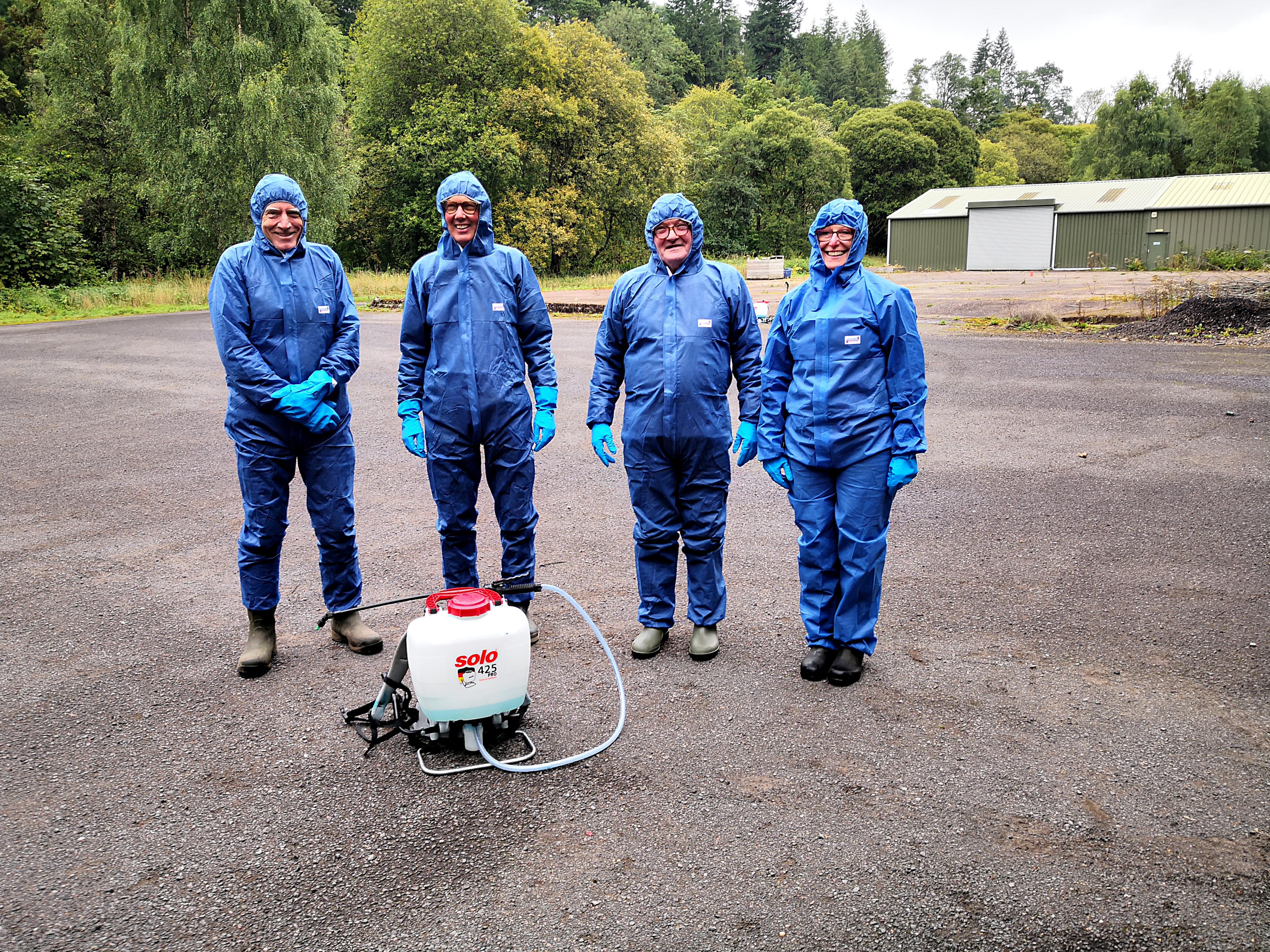
The 4 local volunteers (mentioned above) have now completed their training – a 2-day PA6 course for the professional use of pesticides and they all passed their theory test with flying colours! This was followed by a practical assessment about a week later. Well done, folks! They are now ready to start tackling the Japanese knotweed in and around Fearnan, under the careful supervision of SISI’s Mark Purrman-Charles.
And here they are ready for action:
More Recycling Opportunities
Recycling opportunities in at Clach an Tuic in Fearnan have again expanded and you can now recycle:
- the flexible pouches for all brands of coffee beans and ground coffee.
- all brands of air, home and laundry products.
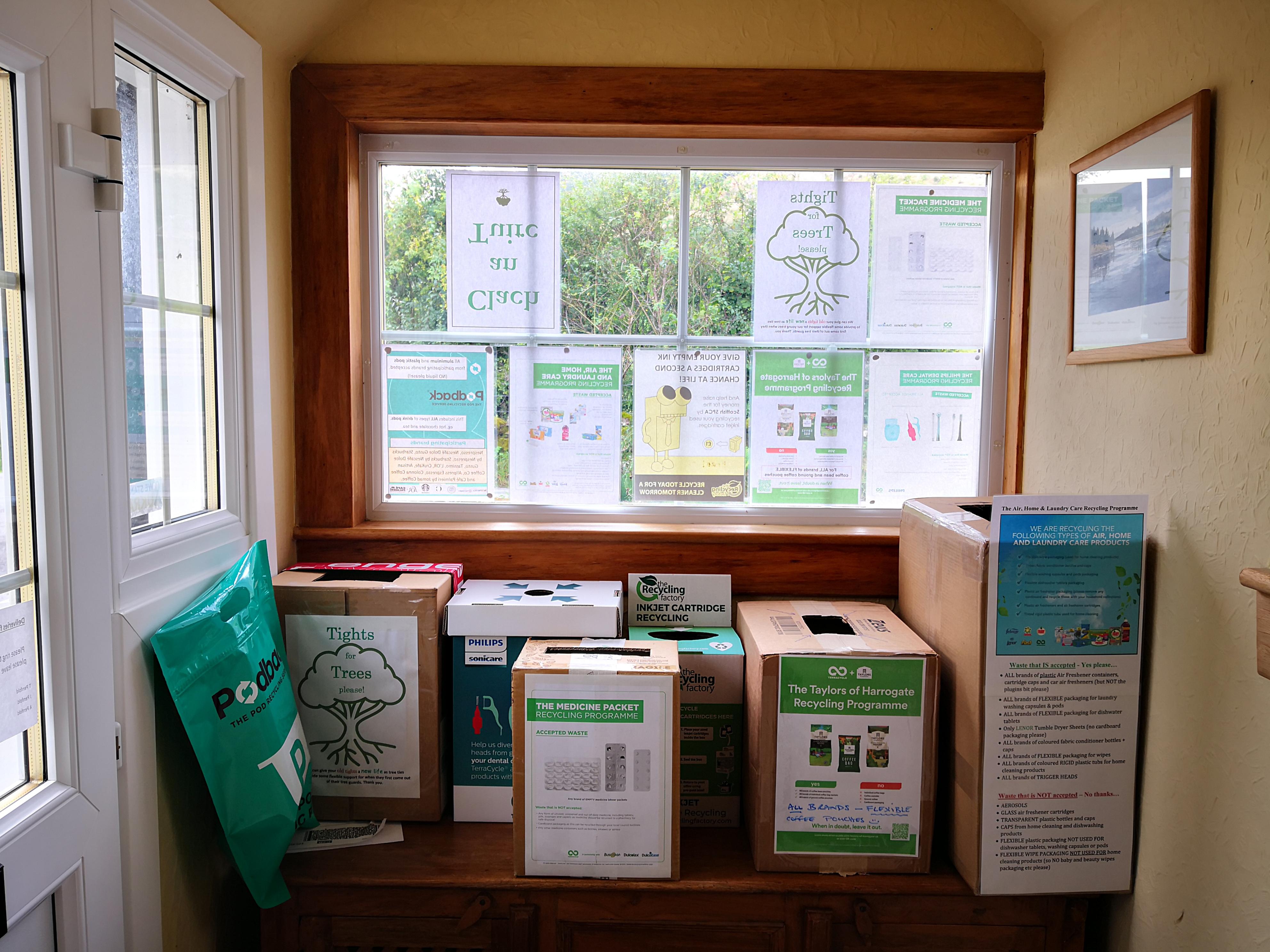
As a reminder, the following items can be recycled at Clach an Tuirc:
Coffee pods
Tights
Dental products – electric toothbrush and flosser heads, flossing sticks, interdental brushes and dental floss containers
Medicine foils
Inkjet cartridges
All brands flexible coffee pouches
All brands plastic air freshener containers, cartridge caps and car air fresheners
All brands flexible packaging for laundry washing capsules and pods
All brands flexible packaging for dishwasher tablets
Only Lenor Tumble Dryer sheets
All brands flexible packaging for wipes
All brands trigger heads
For ease of reference going forward, a new Recycling page has been created on www.fearnanvillageassociation.com with the list of items that can’t go in your blue bin but can be recycled in the boxes at Clach an Tuirc. The link to the Recycling Page appears at the top of the home page, under the header photo.
Fearnan Book Club
Linda writes:
In September we reviewed The Couple at Number 9 by Claire Douglas. This book was chosen by a member who, like many of the group, enjoys crime novels. When she read that two bodies had been discovered practically on the first page, she thought it would be a good choice!
This was murder with a difference as both deaths had taken place many years before the bodies were discovered in the garden of a cottage inherited by a young couple. A nightmare scenario which soon became fraught with emotion.
It was an easy read, fairly predictable, enjoyable and for some a page-turner. Some found it confusing with characters changing names and identities. All agreed that the interesting characters were well portrayed and found it easy to empathise with those most affected by the events. Especially Lorna, who discovered that both her parents had been murderers! We sympathised with Rose who suffered from dementia but felt that perhaps this enabled her to hide information.
There were a few twists which most of us didn’t see coming and it was felt that perhaps all was wrapped up too tightly at the end.

The book to be reviewed in October is The Survivors by Jane Harper. As a group we have enjoyed and reviewed a few of her books set in Australia.
This book is set in coastal Tasmania and is described as a powerful and absorbing thriller ………
………..a body found on the beach in a small coastal town triggers a chain of questions and tears open old wounds.
MacMillan Coffee Morning
Fearnan Village Hall Committee is hosting a Coffee Morning for MacMillan Cancer Support in the hall on Saturday 1st October at 10.30. All welcome.
And finally……….
Just a reminder that there will be an Extraordinary AGM for Fearnan Village Association members on Saturday 17th at 17.00 in the village hall. The purpose is to approve the Association’s accounts for the years 2019 – 20, 2020 – 21, 2021 – 22.
The AGM for 2022 – 23 will be held in Spring 2023.

 Fearnan Village Association